
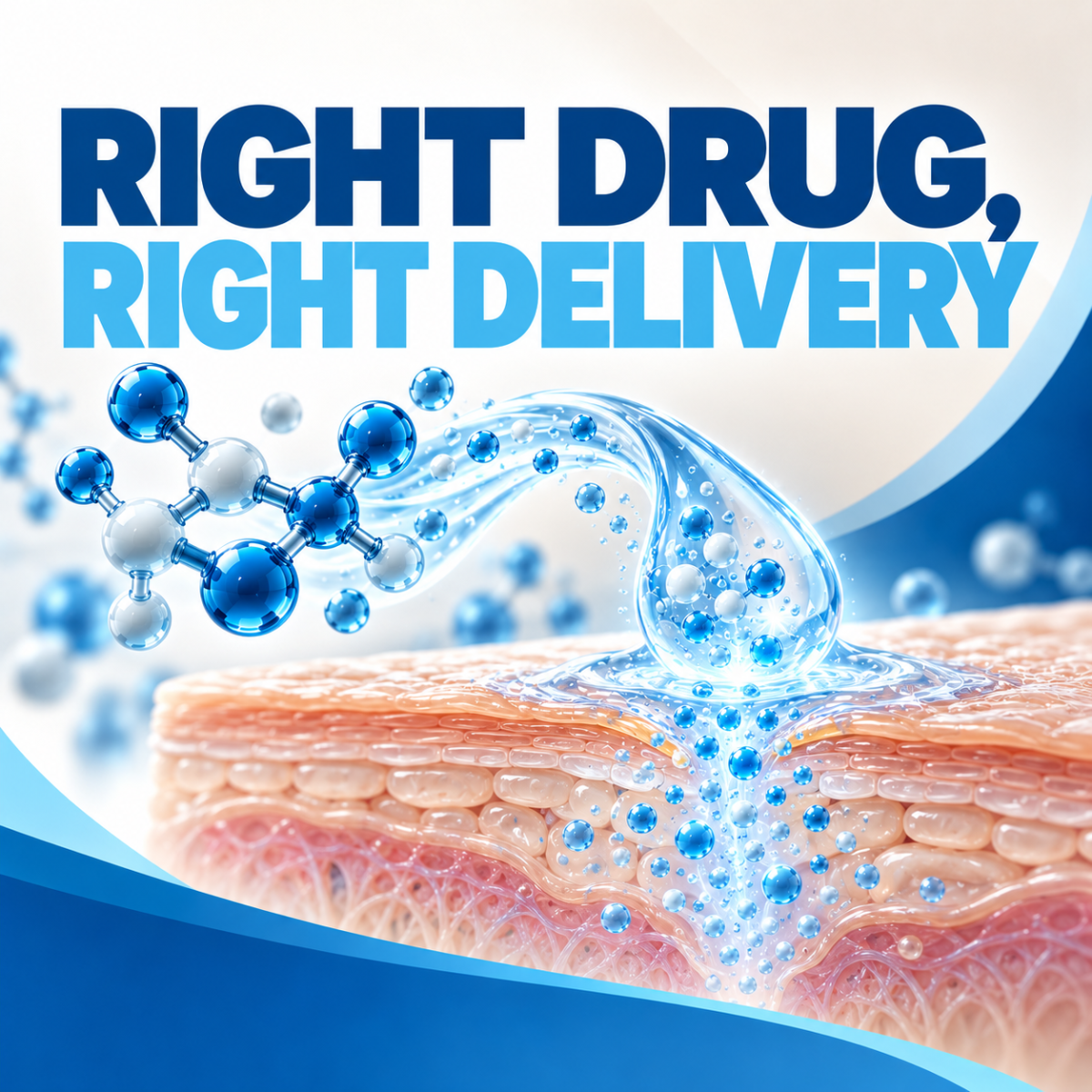
Successful topical drug development requires more than identifying an effective active pharmaceutical ingredient (API). Clinical performance depends on optimizing three interdependent factors: the drug, the disease, and the delivery system. A formulation that works well for one indication or patient population may be suboptimal for another, even when the same API is used.
The goal of topical formulation development is to deliver the appropriate concentration of drug to the target site while maintaining stability, manufacturability, and patient acceptance. As a result, dosage form selection should be driven by the target product profile rather than formulation convenience alone.
Matching the Delivery System to the Disease
Different dermatological conditions create unique formulation requirements. Acute inflammatory diseases often benefit from elegant, readily spreadable formulations that provide rapid symptom relief and a pleasant patient experience. In contrast, chronic dry or hyperkeratotic conditions may require more occlusive systems that enhance skin hydration and prolong drug residence time.
The location of the disease also influences formulation selection. Hair-bearing areas, large body surface areas, oily skin, and sensitive skin regions each present different application challenges. Selecting a dosage form that patients find comfortable and convenient can significantly improve treatment adherence and ultimately influence clinical outcomes.
Understanding the Advantages of Different Topical Formulations
Creams: The Balance Between Efficacy and Elegance
Creams remain among the most widely used topical dosage forms because they offer a balance between drug delivery, patient comfort, and cosmetic acceptability. Their emulsion-based structure can accommodate a broad range of APIs while providing a non-greasy skin feel.
From an aesthetics perspective, creams are often preferred because they spread easily, absorb relatively quickly, and leave minimal residue. These attributes make them particularly attractive for chronic dermatological therapies where long-term patient adherence is essential.
Ointments: Maximum Occlusion and Barrier Protection
Ointments provide the most occlusive topical environment and are particularly useful for dry, scaly, or chronic skin conditions. By reducing transepidermal water loss, ointments can increase hydration of the stratum corneum and improve delivery of certain drug molecules.
However, their greasy feel, shine, and tendency to transfer to clothing may reduce patient acceptance, especially when treatment is required during daytime activities or on visible areas of the body. Although therapeutically effective, ointments often represent a compromise between performance and cosmetic elegance.
Hydrogels: Cooling, Comfortable, and Patient Friendly
Hydrogels contain a high percentage of water and provide a cooling sensation upon application. They are frequently used when patient comfort and cosmetic elegance are priorities.
These systems are particularly attractive for inflamed or sensitive skin because they feel light, non-greasy, and refreshing. Hydrogels also tend to disappear quickly after application, which many patients associate with a premium user experience and may improve treatment compliance.
Non-Aqueous Gels: Enabling Challenging APIs
Many modern APIs exhibit poor aqueous solubility, creating challenges for conventional gel formulations. Non-aqueous gels can improve API solubilization while maintaining desirable application properties.
These formulations typically provide a smooth, elegant appearance and rapid drying characteristics. They are particularly valuable when high drug loading, enhanced stability, or improved delivery of lipophilic molecules is required. From a patient perspective, non-aqueous gels often combine the aesthetics of a gel with the performance benefits needed for difficult-to-formulate compounds.
Sprays and Foams: Convenience and Coverage
Sprays and foams continue to gain popularity because they offer unique advantages for both patients and clinicians. Their ability to quickly cover large treatment areas and hair-bearing regions makes them especially useful for conditions affecting the scalp or extensive body surfaces.
Aesthetically, sprays and foams are often viewed as modern, convenient dosage forms. They spread easily, require minimal rubbing, and typically leave little residue after application. These characteristics can improve patient satisfaction and support long-term adherence, particularly when frequent application is required.
Optimizing for Commercial Success
The most successful topical products emerge from a development strategy that simultaneously evaluates drug properties, disease requirements, delivery system capabilities, and patient preferences. Solubility, skin penetration, stability, excipient compatibility, manufacturability, and aesthetics all contribute to product performance.
Early consideration of these factors helps reduce development risk and supports more informed formulation decisions. Ultimately, the optimal topical formulation is not simply the one that delivers drug effectively. It is the formulation that delivers therapeutic benefit while providing a patient experience that encourages consistent and long-term use.
References
- Barry BW. Novel Mechanisms and Devices to Enable Successful Transdermal Drug Delivery. European Journal of Pharmaceutical Sciences. 2001;14(2):101-114.
- Benson HAE. Transdermal Drug Delivery: Penetration Enhancement Techniques. Current Drug Delivery. 2005;2(1):23-33.
- Brown MB, Martin GP, Jones SA, Akomeah FK. Dermal and Transdermal Drug Delivery Systems. Drug Delivery. 2006;13(3):175-187.
- Lane ME. Skin Penetration Enhancers. International Journal of Pharmaceutics. 2013;447(1-2):12-21.
- Prausnitz MR, Langer R. Transdermal Drug Delivery. Nature Biotechnology. 2008;26(11):1261-1268.
- Williams AC, Barry BW. Penetration Enhancers. Advanced Drug Delivery Reviews. 2012;64:128-137.